Infectious Disease Research
The Wake Forest School of Medicine Section on Infectious Diseases integrates clinical excellence, epidemiology, and data‑driven modeling to address emerging and endemic infectious threats.
Advancing Infectious Disease Research, Surveillance, and Public Health Response
The Wake Forest University School of Medicine Section on Infectious Diseases integrates clinical excellence, epidemiology, and data‑driven modeling to address emerging and endemic infectious threats.
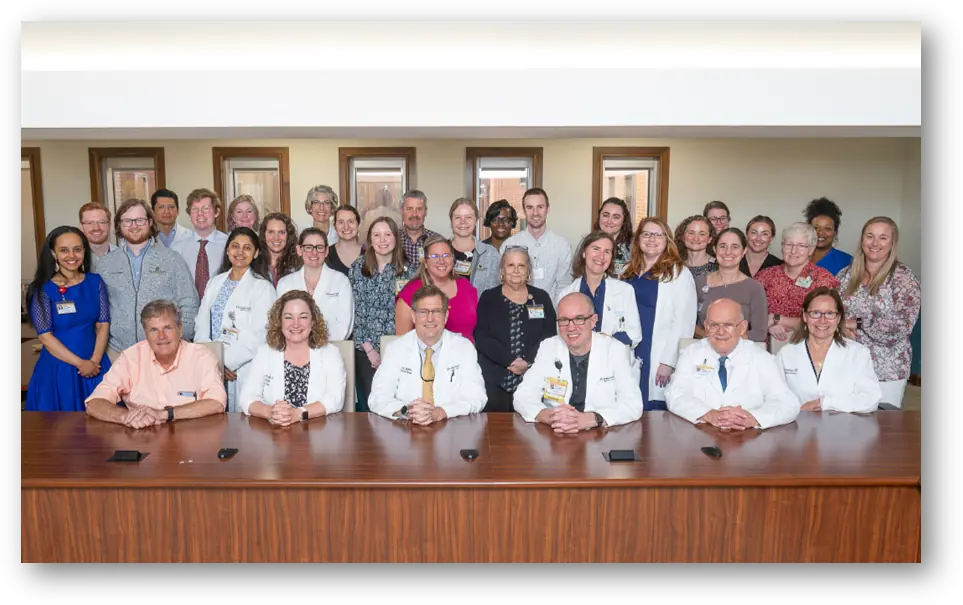
Wake Forest University School of Medicine Section on Infectious Diseases is home to not only excellence in clinical care but also research and education. Our infectious diseases specialists are recognized locally, nationally and internationally for their expertise in treating all types of infectious diseases. We are home to professional researchers, clinical trialists, and support staff engaged in everything from basic and translational research to infectious disease epidemiology and public health. Learn more about our team and the research programs driving this work.
Read more about our latest news and insights!
Respiratory Virus Surveillance
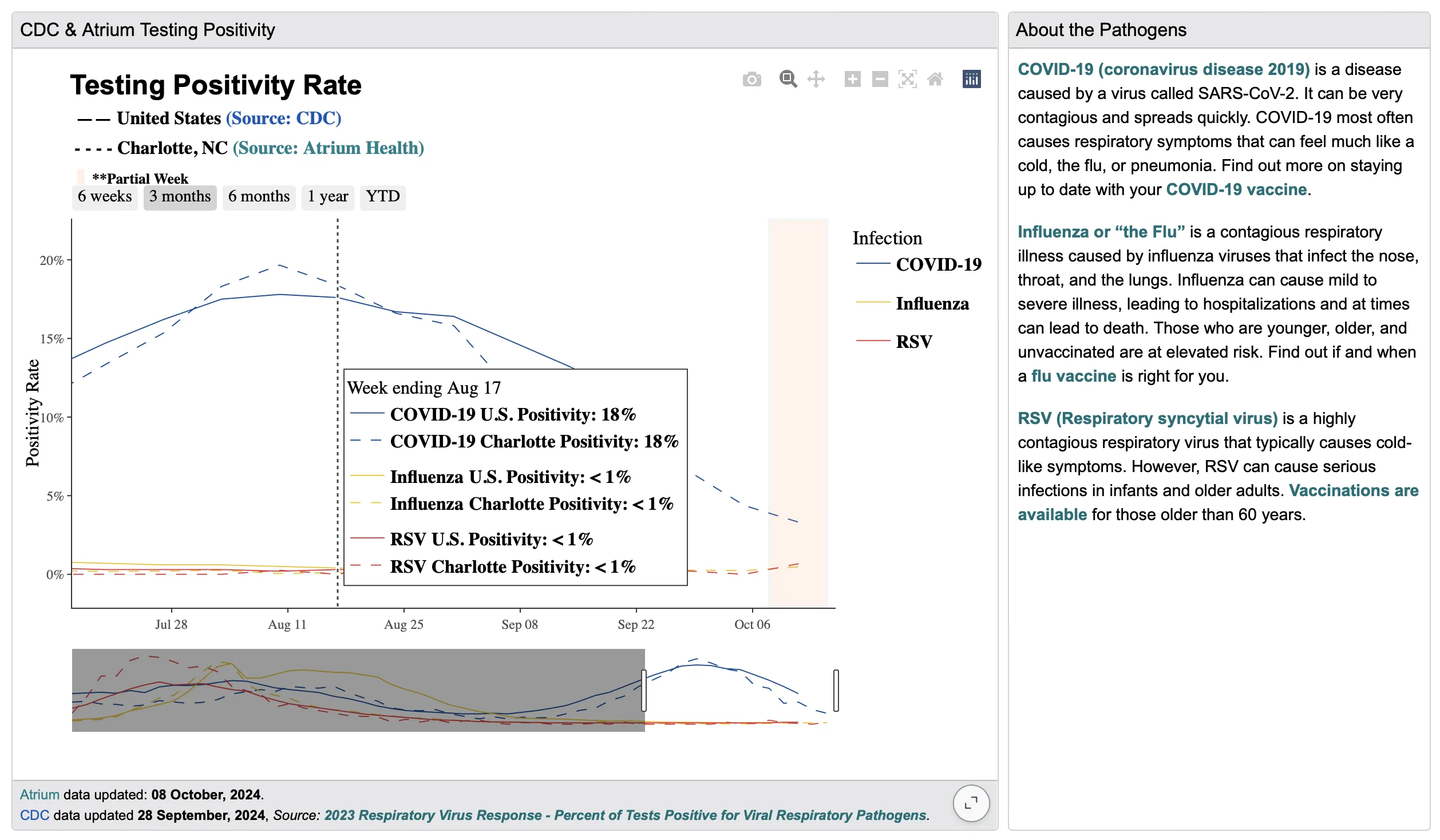
Check out our current work on respiratory virus surveillance. This includes COVID-19, influenza, RSV, and other respiratory viruses. As part of a Duke Endowment grant, we are working to improve respiratory virus surveillance in North Carolina and communicating the results directly to the public and our public health partners.
Our Research Programs
Our research spans vaccine development, HIV clinical trials, antimicrobial stewardship, epidemiology and data science, and clinical research. See our publications or read our latest news.
Recent publications
Social Media and Crisis Care Principles During Pandemics and Disasters: A Consensus Report From a Subgroup of the Task Force for Mass Critical Care.
Mechanistic Assessment of Norepinephrine Therapy versus Angiotensin-II in Septic Shock (MANTRA): Study Protocol for a multicenter randomized trial.
Molecular identification of Rickettsia conorii subsp. israelensis and other tick-borne pathogens in dog ticks from the Upper East region of Ghana.
Post-Infectious Sequelae Following a Shiga Toxin-Producing Escherichia coli Outbreak Among US Marine Corps Recruits.
Desperate Times and Good Science: Lessons From Randomized, Embedded, Multifactorial Adaptive Platform Trial for Community-Acquired Pneumonia (REMAP-CAP).
Non-myeloablative conditioning regimens: Fludarabine/busulfan or fludarabine/cyclophosphamide/total body irradiation for allogeneic stem cell transplant.
Clinical factors associated with central line-associated bloodstream infections in hospitalized dialysis patients.
Publisher Correction: Surviving Sepsis Campaign: international guidelines for management of sepsis and septic shock 2026.
Clinical Criteria for the Definition of Refractory Septic Shock: A Joint Delphi Consensus from the Society of Critical Care Medicine (SCCM) and European Society of Intensive Care Medicine (ESICM).
Clinical criteria for the definition of refractory septic shock: a joint Delphi consensus from the Society of Critical Care Medicine (SCCM) and European Society of Intensive Care Medicine (ESICM).
Gaps and Strategies for Management of Sepsis in Low-Resource Settings: Expert Consensus Statements Using a Delphi Method.
The Frame of Survival for Sepsis: A Practical Systems Framework for Time-Sensitive Critical Illness in Low-Resource Settings.
Bridging the Gap: A Needs Assessment of Resources and Support for International Medical Graduates Navigating Visa-related Career Decisions in Infectious Diseases.
Executive Summary: Surviving Sepsis Campaign: International Guidelines for Management of Sepsis and Septic Shock 2026.
Vaccines for healthcare personnel: a core safety measure a position statement from the Society for Healthcare Epidemiology of America (SHEA).
Comparison of Minimum Inhibitory Concentration as Measured by Etests and Agar Dilution in Neisseria gonorrhoeae Isolates from North Carolina, 2018-2024.
Necrotizing soft-tissue infections survival guide in adult patients: A position statement by the Global Alliance for Infections in Surgery.
Healthcare Workers Have More Frequent and Less Severe Influenza-Like Illness Than Non-healthcare Workers: Findings From the PAIVED Study.
Occurrence of Tick-Borne Pathogens in Rhipicephalus sanguineus Sensu Lato From Domestic Dogs in Kumasi, Ghana.
Society for Healthcare Epidemiology of America supports environmental stewardship and sustainability while protecting patients and healthcare personnel position statement of the SHEA Board.
Knowledge, Attitude and Practices of Abattoir Workers in Kumasi Towards Ticks and Tick-Borne Pathogens.
Distinct microbiota profiles in non-survivors in preterm infants with surgical necrotizing enterocolitis: Insights from FFPE intestinal tissue analysis.
Faecal pharmacokinetics, microbiome, and bile acid changes in healthy subjects given intravenous followed by oral omadacycline; a Phase 1 clinical trial.
Cardiovascular Physiology During Mechanical Circulatory Support: Implications for Management and Monitoring.
Society for Healthcare Epidemiology of America (SHEA) infectious diseases fellow infection prevention and control and healthcare epidemiology curriculum.
Nitazoxanide and tizoxanide demonstrate high levels of in vitro activity against metronidazole-susceptible and metronidazole-resistant Trichomonas vaginalis clinical isolates.
Beyond the hospital doors: challenges and insights from a multi-state healthcare system outpatient infection prevention program.
Clinical Characteristics and Outcomes of Cardiac Findings in Young Persons Following SARS-CoV-2 Infection.
Association of Cardiologist Clinic Visits With Cardiovascular Primary Prevention Outcomes Among People With HIV From Underrepresented Racial and Ethnic Groups in the Southern United States.
Magnetoencephalography Reveals Neuroprotective Effects of COVID-19 Vaccination in Non-Human Primates.
Challenging a paradigm: Staggered versus single-pulse mass dog vaccination strategy for rabies elimination.
Retrospective cohort study of the microbiology and clinical outcomes of spontaneous bacterial peritonitis (SBP) within a US academic health system.
Train with us
The Wake Forest University School of Medicine Infectious Disease offers a variety of training opportunities for undergraduates, medical students, residents, fellows, and pharmacy residents. Learn more about our training opportunities.
Support our work
Every gift contributes to our mission of building a better future for all. To learn more about how you can support the Section on Infectious Diseases, please contact the Office of Philanthropy at philanthropy@wakehealth.edu or give online below.
Please put “Section on Infectious Diseases” in the comments field when you give online.
Upcoming events
Please check back later for upcoming events
Past events

Endemic Mycoses
Duane R. Hospenthal, MD, PhD – Section Chief, Infectious Diseases, Baptist Health System, San Antonio, TX; Clinical Professor, University of the Incarnate Word School of Medicine, San Antonio, TX
Duane R. Hospenthal, MD, PhD, FACP, FIDSA, FASTMH, is a preeminent international authority in medical mycology and fungal diseases, with more than three decades of leadership in clinical care, research, and education. Trained at Michigan State University and the NIH, he has authored hundreds of peer‑reviewed publications and edited the definitive multiedition reference Diagnosis and Treatment of Fungal Infection, shaping modern understanding and management of invasive and emerging mycoses.


Navigating the noise: how to combat misinformation
Elisabeth Marnik, Ph.D. (Speaker) – Executive Director, The Evidence Collective
Dr. Elisabeth Adkins Marnik is a scientist, educator, and nationally recognized science communicator dedicated to making science accessible, engaging, and relevant to all audiences. As the Executive Director of The Evidence Collective, she leads national efforts to translate evidence into accessible, responsible public communication and to support independent voices working at the intersection of science, health, and policy.
M. Elle Saine, MD, PhD, MA (Moderator) – Postdoctoral Fellow, Infectious Diseases, Perelman School of Medicine, University of Pennsylvania
M. Elle Saine, MD, PhD, MA is an infectious diseases physician-scientist at the Hospital of the University of Pennsylvania whose research examines how stigma shapes health care access, policy, and equity. Her work focuses on the intersection of infectious disease epidemics—including HIV and viral hepatitis—and the opioid crisis, using innovative mixed methods approaches to identify and reduce structural barriers to care.

Infectious diseases and Public Health- A global perspective with focus on the Middle East
Dr Rana Hajjeh – Former Director of Programme Management World Health Organization (WHO)
Dr Hajjeh is a senior public health leader with 30 years experience in global health, infectious diseases epidemiology, health policy and diplomacy, and health management, especially in the Eastern Mediterranean Region.

Building Infectious Disease Surveillance Platforms
Dr David Brett-Major – Professor of Infectious Diseases and Epidemiology, University of Nebraska Medical Center
David Brett-Major, MD, MPH, is a professor in the Department of Epidemiology of the UNMC College of Public Health and has extensive experience in biosecurity and surveillance.

The evolution of clinical care for the viral hemorrhagic fevers over the years
Dr Dan Bausch – Professor, London School of Hygiene and Tropical Medicine & National University Singapore
Dr Bausch specializes in the research and control of emerging tropical viruses, with over 20 years’ experience in sub-Saharan Africa, Latin America, and Asia combating viruses such as Ebola, Lassa, hantavirus, and SARS coronavirus. He places a strong emphasis on capacity building in all his projects and has a keen interest in the role of the scientist in promoting health and human rights.

The CRISPR toolbox and its applications in medicine: infectious disease, microbiome and therapeutic applications.
Dr Rodolphe Barrangou – Todd R. Klaenhammer Distinguished Professor, North Carolina State University
Dr. Barrangou established the functional role of CRISPR-Cas as adaptive immune systems in bacteria. He has focused on establishing the molecular basis for their mechanism of action, as well as developing and applying CRISPR-based technologies for genotyping, building immunity and genome editing.

Update on the management of neurocysticerosis
Dr Christina Coyle – Professor of Medicine and Pathology, Albert Einstein College of Medicine
Dr. Coyle runs an active clinic at Jacobi Medical Center where she trains fellows, medical students and residents. She co-directs the American Society of Tropical Medicine Annual Intensive Update Course.

Fungus Among US: Emerging Fungal Resistance, Candida Auris And Beyond
Dr Tom Chiller – Chief, Mycotic Diseases Branch; Associate Director for Global Health, Division of Foodborne, Waterborne, and Environmental Diseases, Centers for Disease Control and Prevention, USA
At the CDC, Tom Chiller provides leadership for fungal disease activities, which include detection, prevention and response activities, policy and advocacy, both nationally and internationally. He also serves as the associate director for global programs in the Division of Foodborne, Waterborne, and Environmental Diseases. He remains actively involved in antimicrobial resistance, healthcare associated infections, molecular epidemiology and laboratory activities for fungal diseases.